Introduction: The Role of Backlight Modules in LCDs

The backlight module is one of the main components in liquid crystal displays (LCDs). As liquid crystals themselves lack the ability to emit light, the function of the backlight module is to provide sufficient brightness and a uniformly distributed light source, making the display show images correctly. Backlight modules are currently widely used in electronic products with growth potential, such as monitors, laptops, and projectors. Consequently, demand for backlight modules and their related components continues to grow. Driven by the trend towards lower panel prices, demand for large-sized panels—particularly in notebook computers and LCD monitors—remains the primary growth driver for backlight modules.
Types of Backlight Modules
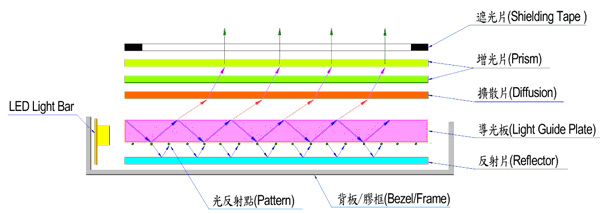
Backlight modules are primarily categorized into front-lit and back-lit types. Back-lit modules can be further subdivided based on light source positioning into edge-lit, bottom-lit, and hollow-type structures.
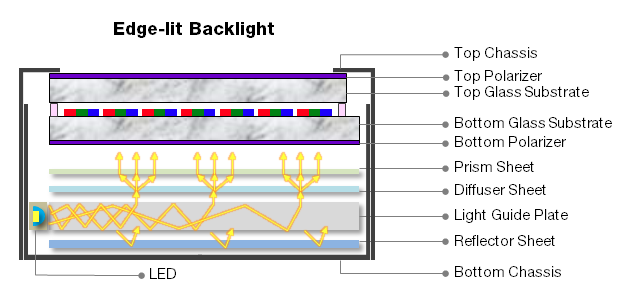
Edge-Lit Backlight Modules

The edge-lit structure features light sources positioned along the sides, employing injection-moulded light guides without printed circuits. This design is suitable for small-sized backlight modules under 18 inches, offering advantages such as lightweight construction, slim profiles, narrow bezels, and low energy consumption. It is commonly used in backlight modules for mobile phones, personal digital assistants (PDAs), and notebook computers. Additionally, edge-lit structures can be applied to large-sized backlight modules.
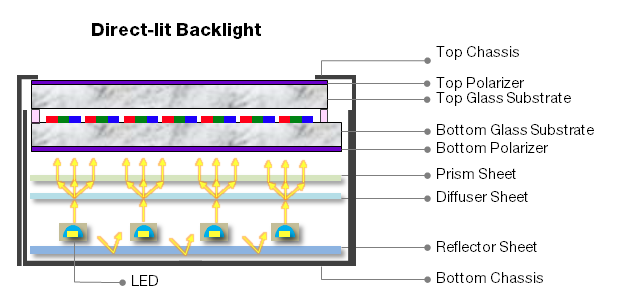
Direct-Lit (Bottom-Lit) Backlight Modules

Direct-lit structures are suitable for ultra-large backlight modules. Characterized by the absence of a light guide plate, the light source is positioned directly beneath the panel. Advantages include high brightness, excellent viewing angles, high light utilization efficiency, and simplified structure. This configuration is appropriate for LCD monitors and televisions where portability and space constraints are less critical. However, drawbacks include high energy consumption, poor uniformity, and potential LCD overheating.
Hollow-Type Backlight Modules
The hollow-type structure is suitable for extra-large LCDs, such as monitors and wall-mounted televisions. This configuration uses air as the medium for light transmission. Light emitted downward is adjusted by prism sheets and reflectors; part of it exits upward through the light guide plate, while another portion is reflected back via total internal reflection. The light guide plate adopts a wedge-shaped structure to achieve uniformity.
Key Optical Components of Backlight Modules
Main optical components within the backlight module include the LED strips, 라이트 가이드 플레이트, adhesive frame, reflector sheet,,, 디퓨저 시트, brightness enhancement film also called 프리즘 영화, and black/white adhesive. To meet demands for increasingly slim backlight designs, some modules incorporate an additional iron frame.
맞춤형 백라이트 솔루션 & 광학 시트 공급 업체 – RNODA 기술