 Aangepaste oplossingen voor achtergrondverlichting & Optische leverancier – Rnoda Tech


In LED lighting, LCD backlighting and various types of optical equipment, PC (polycarbonate) diffuser sheets are a common optical material. Not only do they allow light to pass through, but they also improve light uniformity through scattering, thereby reducing issues such as light spots and localised brightness inconsistencies.
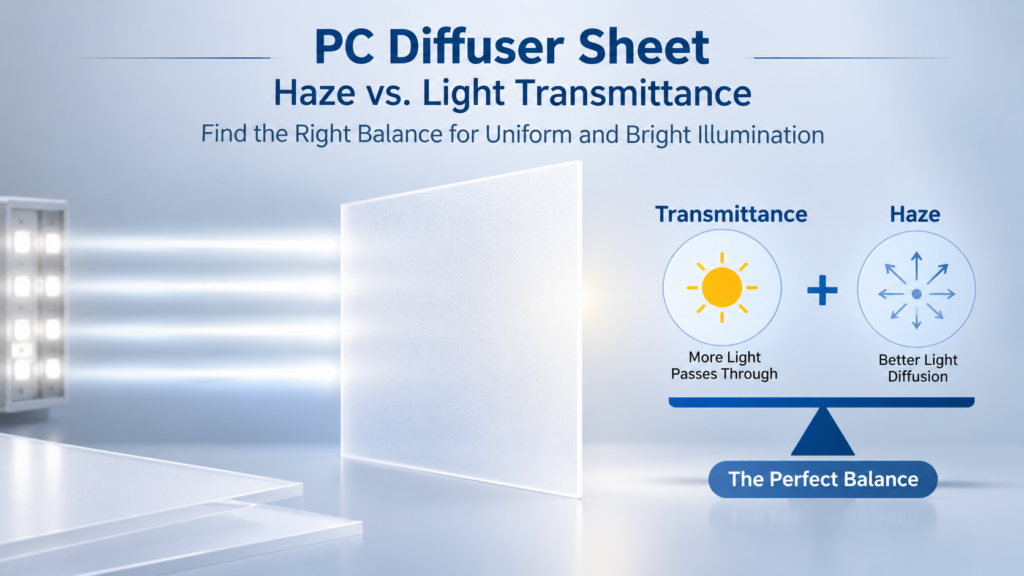
When evaluating the optical performance of PC diffuser sheets, haze and light transmittance are two crucial parameters. They reflect, respectively, the material’s ability to diffuse light and its ability to transmit light. Understanding the relationship between these two parameters helps in selecting the appropriate diffuser sheet for different application requirements.
1) What is the light transmittance of a PC diffuser plate?
Light transmittance refers to the percentage of transmitted light flux relative to the incident light flux after light has passed through the material.
Put simply, the higher the light transmittance, the more light the material allows to pass through, and the less light energy is lost.
For example, if a PC diffuser sheet has a light transmittance of 85 per cent, this indicates that, under specified test conditions, approximately 85 per cent of the incident light passes through the material.
In LED lighting and display backlight applications, light transmittance is directly related to the utilisation efficiency of the light source. If light transmittance is too low, it may result in a reduction in the final luminous intensity; therefore, a suitable selection must be made based on the product’s brightness requirements.
2) What is the haze of a PC diffuser sheet?
Haze refers to the percentage of the total transmitted luminous flux that is scattered at a certain angle by the light passing through the material.
Unlike transmittance, haze primarily reflects the degree to which the material scatters light.
Higher haze generally indicates a more pronounced light diffusion effect, which helps to mitigate localised bright spots produced by LED light sources, resulting in a softer and more uniform light output.
For example, in LED luminaires, if there are noticeable differences in brightness between light sources, using a PC diffuser with an appropriate level of haze can improve light distribution and reduce spots visible to the naked eye.
3) What is the relationship between haze and light transmittance?
In PC diffuser sheets, haze and light transmittance usually need to be considered in conjunction, but the two do not follow a simple inverse relationship.
Generally speaking, to enhance the light diffusion effect, diffusing particles may be added to the material, or the direction of light propagation may be altered through surface texturing.
When light passes through these structures, it undergoes varying degrees of scattering. In some cases, a portion of the light may be lost due to multiple scattering, reflection or absorption, thereby affecting the material’s light transmittance.
Consequently, when other conditions are similar, enhancing the diffusion effect may be accompanied by a decrease in light transmittance.
However, this does not mean that higher haze necessarily results in lower light transmittance.
By optimising the type, particle size, addition ratio and distribution of the diffusing particles, and combining this with material thickness and surface structure design, it is possible to achieve a good diffusing effect whilst maintaining the highest possible light transmittance.
Consequently, the focus of the optical design of PC diffusing sheets is not simply to pursue high haze or high light transmittance, but to find a reasonable balance between the two based on the actual application.
4)What factors influence the haze and light transmittance of PC diffusion sheets?
The final optical performance of PC diffusion sheets is influenced by a variety of factors, primarily including the following aspects:
1. Type and particle size of diffusion particles
The material type, particle size and addition ratio of diffusion particles affect the manner and extent to which light is scattered within the sheet. Different diffusion formulations may result in varying levels of haze and light transmittance.
2. Material thickness
Where the material formulation and other conditions are similar, an increase in sheet thickness typically lengthens the path that light travels within the material, increasing the opportunities for light to be scattered and absorbed, thereby affecting the final optical performance.
3. Surface Treatment Methods
PC diffusion sheets can be treated with various surface finishes, such as single-sided or double-sided matting. Different surface structures alter the scattering characteristics of light and may therefore affect haze, light transmittance and the final light output.
4. PC Raw Materials and Formulations
Different grades of PC resin, additives and diffusion formulations also affect the material’s transparency, optical loss and long-term performance.
5)How to Select a PC Diffuser Sheet Based on Application Requirements?
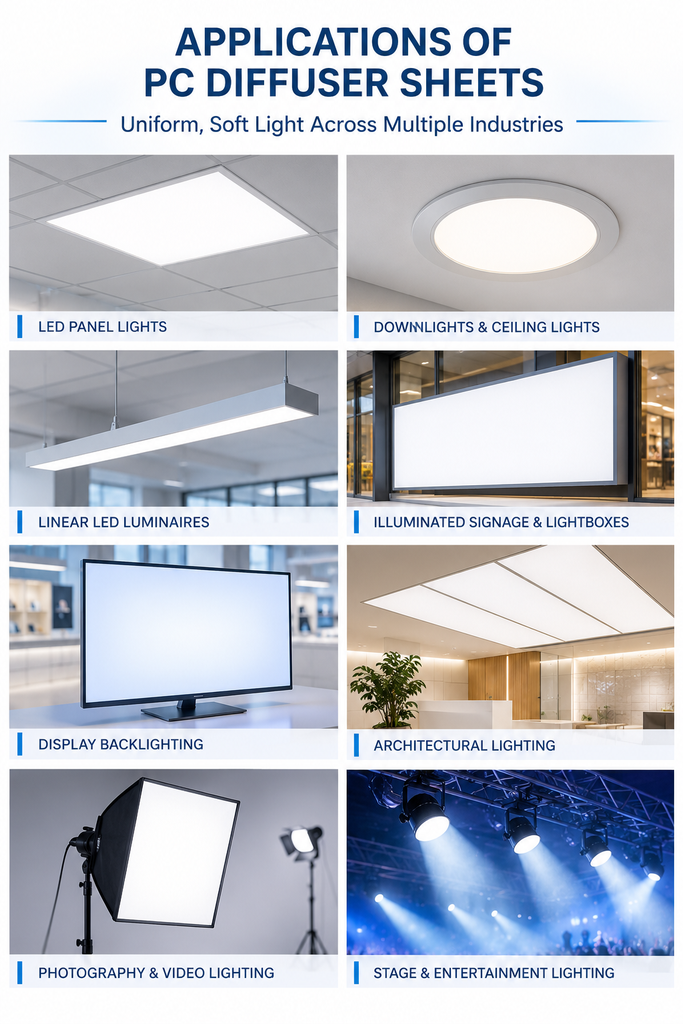
Different applications have varying requirements for haze and light transmittance; it cannot simply be assumed that higher values are always better.
LED lighting applications: Typically, attention should be paid to light uniformity and the ability to prevent LED light spots. For products with a dense distribution of light sources, an appropriate haze level can be selected based on the spacing between light sources and the mixing distance.
LCD backlight applications: It is necessary to balance light diffusion with overall brightness, whilst avoiding any adverse effects on display quality caused by excessive scattering or optical loss.
Electronic devices and other optical applications: In addition to haze and light transmittance, factors such as sheet thickness, surface finish, dimensional accuracy and mechanical properties must also be considered.
When selecting materials in practice, it is advisable to conduct a comprehensive assessment taking into account the type of light source, the LED arrangement, the distance between the light source and the diffuser sheet, as well as the brightness and uniformity requirements of the final product.
Where necessary, practical testing can be carried out using samples of different thicknesses and haze grades to determine the most suitable material specifications.
Samenvatting
Haze and light transmittance are two key indicators for evaluating the optical performance of PC diffuser sheets.
Light transmittance primarily reflects the material’s ability to transmit light, whilst haze reflects the degree of scattering of the transmitted light. The two are interrelated, but there is no fixed proportional relationship between them.
For PC diffusion sheets, what truly matters is not simply pursuing the highest light transmittance or the highest haze, but rather minimising optical loss as much as possible whilst meeting light uniformity requirements, thereby achieving a balance between brightness and diffusion performance.
We specialise in optical materials and bespoke optical components, providing support with material selection and product customisation for LED lighting, display backlighting and other optical applications. Should you require further information regarding the thickness, haze, light transmittance and surface treatment options for PC diffusion sheets, please do not hesitate to contact us.